Sustainable Travel to Scandinavia – Facts Instead of Myths
Introduction
Switzerland is currently having a controversial debate about the planned night train connection from Basel via Copenhagen to Malmö. This new route for 350 passengers per day offers environmentally conscious holiday and business travellers an attractive alternative to flying. But how climate-friendly is the night train really?
Background and criticism:
In the media, the environmental performance of night trains is being discussed controversially. Critics mainly point to the high costs and subsidies. ESU-services has prepared a climate assessment for various travel scenarios – based on robust life cycle assessment data.
Assumptions for the inventory:
Here are the key assumptions for the life cycle assessment of the night train summarised:
Capacity utilisation:
- Assumption of 60% occupancy, as night trains are often fully booked. But, so far, different information found.
- New ÖBB night trains have fewer seats per carriage than day trains (approx. 2/3 of an ICE’s capacity).
Energy demand:
- Night trains run at lower speeds (mostly up to 160 km/h, rarely up to 230 km/h), which reduces electricity consumption.
- Estimate: approx. 0.072 kWh per passenger-kilometre (including conservative assumptions). Comparison: ICE is approx. 0.08 kWh/pkm.
Data sources:
All other calculations are based on European average values from the Swiss KBOB database.
Uncertainties:
- Actual occupancy of all modes of transport is a critical factor.
- Differences in the electricity mix by country can influence the results.
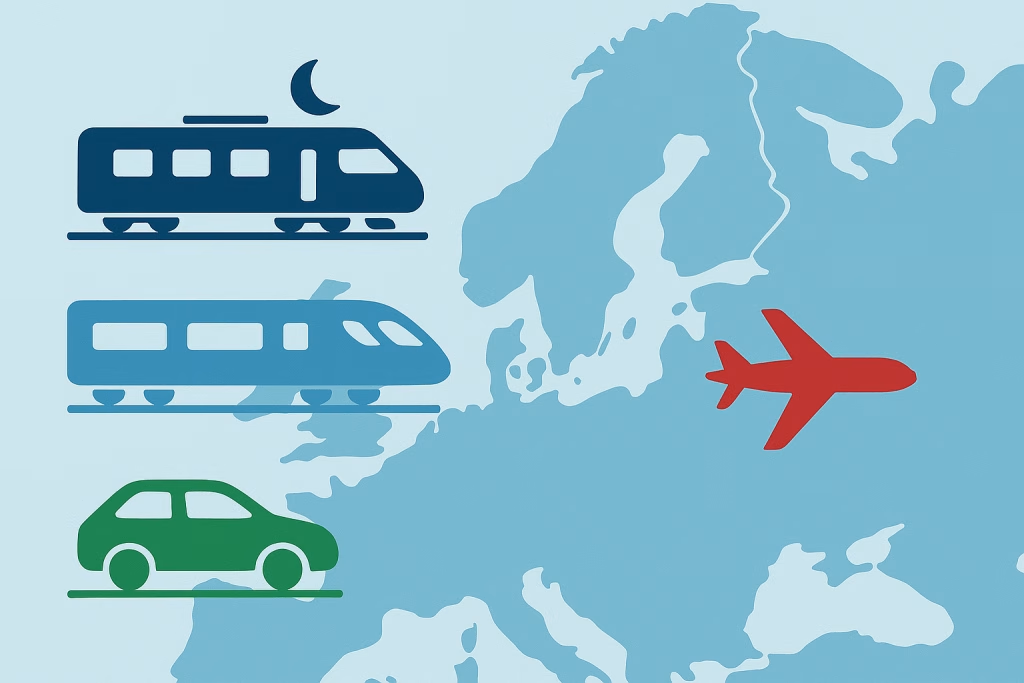
The scenarios examined (each for 2 persons with day train, night train, petrol car, and airplane):
Bern – Copenhagen
- Night train (boarding in Basel)
- Flight from Basel with taxi transfer to and from the airport
Bern – Malmö
- Night train via Copenhagen
- Flight from Basel to Copenhagen with taxi transfer to and from the airport
Bern – Stockholm
- Day train and car, each including an overnight stop, e.g., Hamburg
- For the night train from Malmö, continue by high-speed train (4.30 h) to Stockholm
- Flight from Basel with taxi transfer to and from the airport
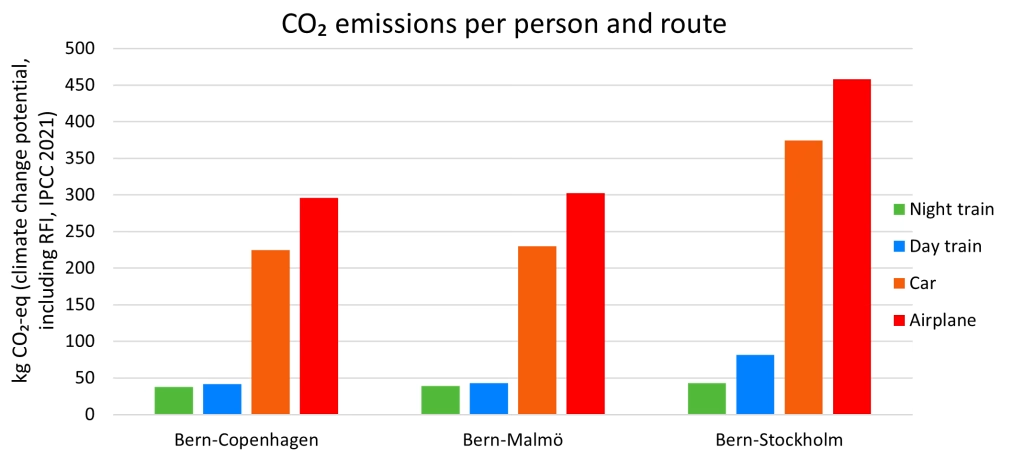
Results of the climate assessment per person and route:
- Day train: slightly higher than the night train, due to higher travel speeds and, if applicable, hotel overnight stays (see Bern–Stockholm scenario)
- Flight: roughly 10 times higher emissions than the night train (including RFI factor for additional atmospheric emission effects)
- Car: significantly worse than train
Conclusion: Night trains are not only comfortable but also one of the most climate-friendly options for travel to Scandinavia.
Additional, unaccounted-for advantages of night trains:
- Use of off-peak electricity at night (better load utilisation of the electricity mix, e.g., wind power)
- Transport of bicycles and luggage
- Business trips without additional hotel overnight stays
- Relaxed start to holiday without early wake-up for airport transfer
Conclusion of the climate assessment for the night train to Copenhagen and Malmö:
The new Basel–Malmö connection is an important step for sustainable mobility in Europe. The night train is an ecologically sensible and socially cost-efficient solution. It offers an attractive option for travellers who take sustainability seriously – and at a fraction of the cost of current technological CO₂ removal from the atmosphere.



