New Background Database is now online!
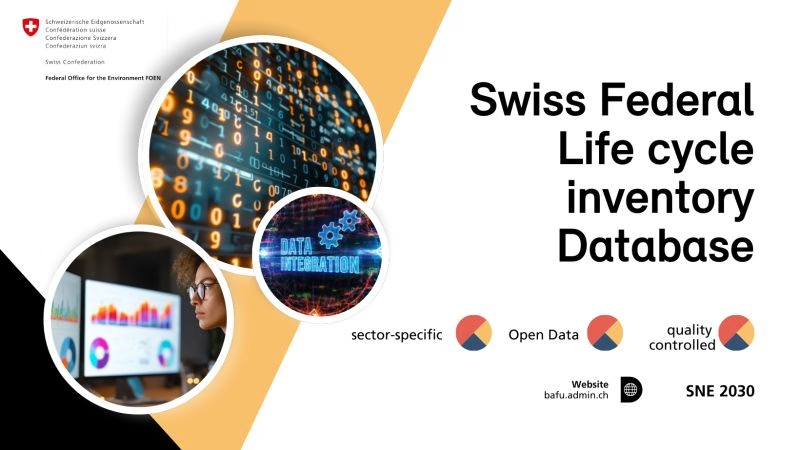
With BAFU:2025, the Swiss Federal Office for the Environment (FOEN) provides a high-quality, open and freely available life cycle inventory (LCI) database tailored to Swiss needs.
🔍 What’s inside?
• Cross-sectoral LCIs (energy, industry, transport, etc.)
• Free use
• Up-to-date, transparent and externally reviewed
• Compatible with major LCA software (OpenLCA, Brightway, SimaPro, Umberto)
🌍 Why it matters:
The database supports environmental legislation, enables sustainable decision-making in administration, research and industry – and strengthens transparency in life cycle assessment.
🤝 Get involved:
The LCA community is invited to make specific suggestions for improvement. You are also welcome to send your own high-quality LCIs so that it can be checked whether they can be integrated before the next publication. Let’s shape the future of environmental data together.
📥 Discover, Download and contribute
ESU-services contributed several hundreds of datasets
ESU-services is proud to contribute to this development of a public LCI database several hundred datasets, including for example updates for fossil fuels and plastics. Soon these data will be used as a background database for our offers on the ESU food database, data-on-demand and emission factors.
More information about the Swiss Federal Administration LCI Database (BAFU:2025)
The Swiss Federal Administration uses life cycle inventories (LCIs) for environmental impact analysis, legal enforcement, and sustainable public procurement. To ensure transparency and reliability, the Federal Office for the Environment (BAFU) coordinates and publishes these inventories in the database BAFU:20XY, which is freely available according to the Open Government Data strategy.
Scope and Content
The 2025 version of the database contains about 11000 LCIs for products and processes in 176 categories that include sectors such as construction, mobility, energy, metals, chemicals, paper, agriculture, food, consumption, and waste management. Data are regularly updated to reflect technological developments.
Data Format and Quality
Data are provided in ecospold V1 and zolca format, compatible with various LCA software and scripts (Python, R). Soon, data will be available for SimaPro. All datasets comply with BAFU DQRv2:2023 and most have undergone critical review for ISO 14040 compatibility. Transparency is ensured through accompanying reports.
Access and Use
Data are free of charge but require acceptance of terms of use:
- No resale is allowed
- Mandatory source citation: Database of the Swiss Federal Administration, BAFU:2025, Federal Office for the Environment, 2025.
BAFU:2025-database – an important milestone
With the publication of the BAFU:2025 database, an important milestone has been reached in the development of life cycle inventory data of the Swiss Federal Administration. The current version of the database is characterised in particular by the following aspects:
- Compatibility with EF 3.1 impact assessment methods
In its current state, the BAFU database is compatible with both the Ecological Scarcity Method (UBP2021) and the Environmental Footprint method (v3.1). As with all databases, however, the specific implementation of impact assessment methods may vary slightly depending on the life cycle assessment software used. - Consideration of regional aspects
The regionalisation of life cycle inventories and impact assessment methods is gaining increasing importance. The BAFU database has only partially taken this development into account so far. The implementation of a systematic regionalisation approach represents an identified need for development. - Data update status, in particular in the agricultural sector
Much of the key data in the BAFU:2025 database has recently been updated. Most of the data in the agricultural sector, however, will be updated over the next two years. Life cycle inventories identified with the label “xx/xxx” are usable in the current version of the database. However, they have been identified as data sets in need of updating in order to better reflect technological developments.
Collaboration and Contact
The Swiss Federal Administration welcomes collaboration for updates and creation of new LCIs.



