Analysis of environmental impacts as a scientific basis for Swiss dietary recommendations
Dietary recommendations guide consumers and teachers in making good food choices. What we eat affects both human health and the environment. In Switzerland, food is responsible for about 20–25% of total environmental impacts.
Environmental damage also affects health. For example, summer heatwaves caused by the climate crisis can lead to more deaths. If dietary recommendations focus only on nutrition or only on sustainability, both health and the environment will suffer.
ESU-services prepared a report combining both aspects to support healthy and environmentally friendly nutrition.
Background: Revision of Swiss Dietary Recommendations
In 2020, the Federal Food Safety and Veterinary Office (FSVO) started a project to revise Swiss dietary recommendations. ESU-services led the “sustainability” work package.
During the project, disagreements arose about how to prioritize health versus sustainability. As a result, the commissioner CHUV ended the collaboration without paying for the final report.
ESU-services has worked on LCA and sustainable nutrition for more than 25 years. Based on this long experience, ESU compiled the full report independently (–> Analysis of food and environmental impacts as a scientific basis for Swiss dietary recommendations).
Key Questions for Sustainable Nutrition
The report answers several central questions:
- What are the environmental impacts of different foods?
- Which foods cause particularly high impacts?
- Where do health and environmental goals align? Where do they conflict?
- How can these conflicts be solved?
- What is especially relevant for Switzerland?
- How can the results inform revised dietary recommendations?
The study uses life cycle assessment (LCA) with the Ecological Scarcity 2021 method. It includes production, processing, transport, storage, and supermarket distribution.
Functional Units Consider Nutritional Value
Different functional units were used to reflect the nutritional role of each food:
- per 100 g
- per 100 kcal
- per nutritional value (e.g., protein content)
Results of the Environmental Assessment
- Per 100 g: Animal products and oils have the highest impacts.
- Per 100 kcal: Meat and fish generate the highest impacts.
- Per nutritional value: Many plant-based foods can meet nutrient needs at much lower environmental cost.
For example, daily protein needs can be met with grains instead of meat, significantly reducing impacts.
The report also shows how production, processing, transport, and storage affect the results. Most impacts occur during agricultural production.
Conflicts and Synergies: Environment and Health
The study shows which foods support both health and sustainability, and where trade‑offs occur. Many conflicts can be solved by choosing alternative foods:
- Replacing animal products with plant-based foods
- Using meat substitutes to meet specific nutrient needs
Environmental improvements can be achieved by:
- More sustainable production methods
- Policy measures encouraging low-impact farming
- Consumer choices such as eating more plant-based foods
- Choosing seasonal and local products
- Reducing energy-intensive processing and packaging
- Reducing food waste
- Avoiding overconsumption
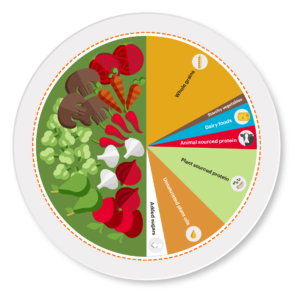
Reducing animal product consumption offers the greatest overall impact reduction. This finding is similar to the planetary health diet.
Conclusions for Swiss Dietary Recommendations
The report concludes with a proposed update of Swiss dietary guidelines that includes sustainability aspects. The revised nutrient recommendations may still require adjustments to fit specific groups better.
Life Cycle Assessment of the New Swiss Dietary Recommendations
On 11 September 2025, the new Swiss dietary recommendations were published. It is best to read the full original version instead of relying on media summaries. ESU-services, supported by WWF Switzerland and Greenpeace, evaluated the recommendations using LCA.
The findings show:
- The new recommendations can reduce environmental impacts if consumers follow them with awareness.
- However, they leave many choices to consumers, making them insufficient to meet environmental goals alone.
- Environmental impacts must also be reduced at the production level.
- Clearer political support is needed for sustainable production and consumption.
Publications and discussion of the dietary recommendations
We see sustainable development as an ongoing and discursive process. Therefore, we are happy to receive comments and suggestions for improvement for a possible revision of this report.
- ESU post: Review of the new Swiss dietary recommendations
- Niels Jungbluth, Angelo Steffanel (2025) Ökobilanz der neuen Schweizer Ernährungsempfehlungen. ESU-services GmbH im Auftrag von greenpeace und WWF Schweiz, Schaffhausen, Schweiz
- Niels Jungbluth, Ujué Fresán (2024) Topical discussion session 4: Recommendations for sustainable dietary patterns in the political debate. Moderation for the 14th LCA Food international conference, 8 – 12 September 2024 Barcelona, Spain
- Niels Jungbluth, Catarina Rocha (2023) Life cycle assessment of novel plant products compared to animal products. EcoSystem meeting on the 4th of April, Life Cycle Assessments (LCA’s) – The holy grail to foster change and convince consumers?
- Niels Jungbluth, Samuel Solin (2022) Life cycle assessment of novel plant products compared to animal products. Parallel Session XV (Sustainable Farming Systems III – Livestock), 13.10.2022, 13th International Conference on Life Cycle Assessment of foods (LCA foods 2022), Lima, Peru
- Niels Jungbluth, Martin Ulrich, Karen Muir, Christoph Meili, Maresa Bussa, Samuel Solin (2022) Analysis of food and environmental impacts as a scientific basis for Swiss dietary recommendations. ESU-services GmbH, Schaffhausen, Switzerland.
- Jungbluth, N. & Frischknecht, R. 2000: Household Food Consumption Patterns: Part B – Evaluation methodologies and indicators. Sustainable consumption: Sector case study series No. ENV/EPOC/GEEI(2000)9/ANN1, ESU-services for Organisation for Economic Co-operation and Development (OECD), Environment Directorate, Project on Sustainable Consumption, 49 pages, Paris.



