Environmental impacts of protein provision by novel food products
Numerous LCA studies have examined the role of meat in our diets. Until 2016, however, no such life cycle assessment data for meat and milk alternatives providing plant proteins was available. Our study on behalf of the Swiss FOEN set out to close this gap.
What we studied
We investigated the environmental impacts of meals and food products based on proteins from plants or fungi, including:
- Sunflower seeds, almonds, mushrooms
- Dried soybeans, chickpeas and lentils
- Canned chickpeas, soy milk
- Pre-fried falafel, tofu, textured soy protein and mycoprotein
For this study, we collected, documented and published new life cycle inventory data covering all stages of the life cycle: agricultural production, processing, distribution, transport to the home, cooling and preparation.
How we analysed the products
We assessed each product by mass, portion, calorific value and protein content. The results show that no single stage dominates across the board:
- For lightly processed foods, agricultural production is the main environmental driver.
- For other products, processing or packaging dominates the footprint.
Key findings
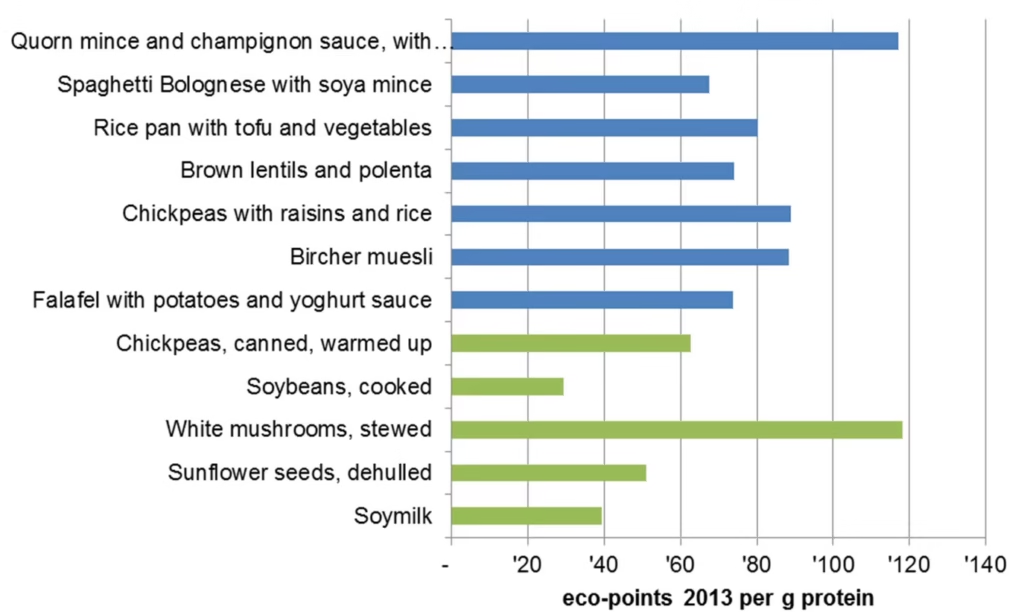
When full meals are compared, the environmental impact is often shaped less by the vegetarian protein source than by the other ingredients in the dish. A high biological value — and therefore high protein availability — depends on combining different products effectively, which is reflected in the recipes we used. For individual portions, however, this biological value is often rather low.
Our conclusion: vegetarian protein products should not be judged in isolation. Other ingredients, storage and preparation at home can considerably change the overall impact. Evaluating a product at the point of sale alone is not sufficient for a full assessment or fair comparison.
After the first project many more followed e.g. on algae, dietary recommendations and mycelial protein biomass (MPB) based novel food products.
Plant based protein products in the news
The 10vor10 evening news discussed the environmental impacts of chicken replacements.
Publications
- PLANTOMYC project started 22/01/2025
- Maresa Bussa, Niels Jungbluth (2022) Life cycle assessment of microalgae as protein source : comparison of drying technologies. Parallel Session XXIV (Sustainable Farming Systems VI – Miscellanea), 13.10.2022, 13th International Conference on Life Cycle Assessment of foods (LCA foods 2022), Lima, Peru
- Jungbluth N., Eggenberger S., Nowack K. and Keller R. (2016) Life cycle assessment of meals based on vegetarian protein sources. In proceedings from: The 10th International Conference on Life Cycle Assessment of Food (LCA Food 2016), University College Dublin (UCD), Dublin, Ireland, 19th – 21st October 2016. Presentation / Paper



