How large is the ecological footprint of euro banknotes in the cash cycle in Germany?
Our newly published study calculates the Product Environmental Footprint (PEF) for euro banknotes in the German cash cycle for the year 2019. It was commissioned by the Deutsche Bundesbank. The analysis covered the phases of issuance, distribution, use, and disposal — the production of the banknotes was excluded. The study is based on the EU-wide recognized Environmental Footprint method (version 3.1).

Results at a glance:
- The environmental impact of the average annual cash payments made by one person amounts to 80 µPt and 1.26 kg of CO₂.
- This corresponds to less than 0.01% of the annual greenhouse gas emissions of a person in Germany.
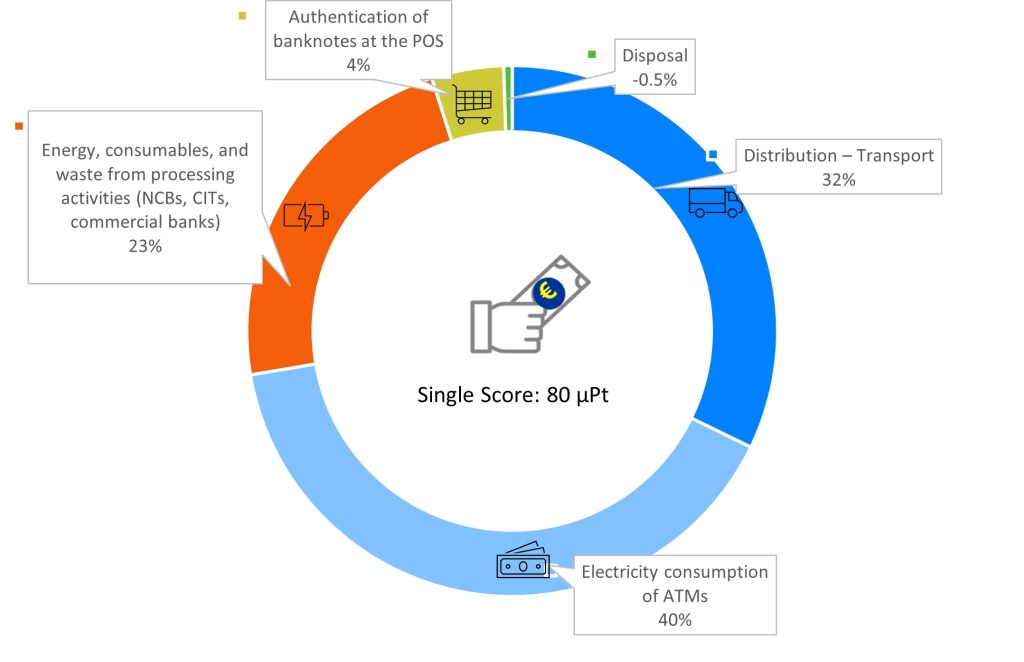
- The main drivers are the transport of banknotes and the electricity consumption of ATMs.
The following chart shows the percentage contributions of individual activities to the overall environmental impact. Particularly relevant are the categories climate change, particulate matter emissions, and acidification, which mainly result from the use of fossil fuels in transport and electricity consumption.
The following improvement potentials were identified:
- Deployment of low-emission or electric vehicles for transportation.
- Transition to a green electricity mix for ATMs.
- Enhancing efficiency in transportation and energy usage.
Compared to other consumption sectors such as mobility or food, the ecological footprint of the cash cycle is negligible. Nevertheless, the results show that targeted measures can further enhance its sustainability.
Executive Summary: LCA of Euro Banknotes Cash Cycle in Germany
Objective of the Study:
The objective of the study is to calculate a Product Environmental Footprint (PEF) for euro banknotes as a means of payment in the German cash cycle, with a particular focus on banknote issuance. This investigation is based on the PEF study for the second series of euro banknotes as a means of payment in the Eurosystem and refers to the situation in Germany in 2019.
The aim of the study is to develop a clear understanding of the ecological footprint of the German cash cycle and to identify opportunities to reduce environmental impacts. The results are intended to support informed decisions on measures to improve the environmental sustainability of the cash cycle. In addition, the study highlights the relevance of the cash cycle in the context of overall environmental impacts in Germany.
Functional unit
The functional unit of the study is defined as “the average annual cash payments per person in Germany in 2019.” The environmental impacts of the cash cycle for banknotes are determined based on the average usage of banknotes by adults in Germany in 2019. The study focuses on the phases of banknote issuance, distribution, usage, and disposal. Unlike the European study, the production of banknotes is not included in the analysis.
Inventory Data on the Cash Cycle
As part of the PEF study for the cash cycle in Germany, a detailed Life Cycle Inventory (LCI) was created, encompassing all relevant inputs and outputs regarding resource use, energy consumption, and emissions of banknotes within the German system. The data collection for the inventory was based on environmental data collected in 2020 for the year 2019. This environmental data was provided by the Deutsche Bundesbank and includes information on the various actors in the cash cycle, such as the national central bank (NCB), cash-in-transit companies (CIT), credit institutions (CI), and retail.
The inventory captures the environmental impacts of all relevant processes and activities in the lifecycle of the banknote circulation considered in the study. This includes the transportation of banknotes, energy consumption for processing and authenticity checks, distribution via ATMs, as well as resource and material use during the distribution and usage phases, including disposal. A key part of the modeling was the allocation of environmental data to the corresponding lifecycle phases and processes. As background data, datasets from the European Commission’s EF database 3.1 were used.
For the modeling of the Life Cycle Inventory (LCI), the software SimaPro 10.2 was used, a well-established licensed software that allows detailed analysis of environmental impacts across the lifecycle of products and services.
Assessment of Environmental Impacts
The assessment is conducted using the Environmental Footprint (EF) method version 3.1, developed by the European Commission to enable a standardized and transparent calculation of the environmental impacts of products.
The results of the PEF study on the environmental impact of the cash cycle in Germany show that the total environmental burden for the functional unit—defined as “the average annual cash payments per person in Germany in 2019”—amounts to 80 µPt (measured in Environmental Footprint units).
Transportation is a key issue
The transportation of banknotes plays a significant role in the overall environmental footprint, as it involves both national and cross-border transport, often requiring additional escort vehicles for security reasons. These results highlight the importance of improving efficiency and the potential role of more environmentally friendly transport methods, particularly through the use of fuel-efficient, low-emission vehicles and electric vehicles where feasible and practical.
However, due to the high security requirements for banknote transportation, conventional specialized vehicles must be used for the time being, for which there are currently no adequate environmentally friendly alternatives. With advancing technological innovations, banknote transport could become more environmentally sustainable in the future, reducing greenhouse gas emissions.
Other relevant factors include ATMs
Another important factor is the energy consumption of ATMs, which are necessary for providing cash to consumers. These machines generate environmental impacts due to their electricity demand, particularly when powered by non-renewable energy sources. Using a greener electricity mix could help reduce these impacts. The contribution of different activities to the total environmental burden is illustrated in the accompanying figure above.
The climate change impact category is important in evaluating the overall environmental footprint. Here, greenhouse gas emissions from transport and energy consumption are particularly relevant. Particulate matter emissions and acidification were also identified as significant impact categories, with transport and the use of fossil fuels across the cash cycle system being the main sources of these emissions.
Improvement potentials
These impacts can be reduced by introducing more environmentally friendly technologies in transportation and energy supply. Switching to renewable energy and using emission-free transport methods could reduce climate impacts and contribute to lower particulate matter and acidification effects.
A sensitivity analysis, examining different scenarios regarding electricity consumption, demonstrates the strong influence of this factor on the results. Reducing the electricity demand of ATMs could significantly lower the environmental impacts of the cash cycle in the areas of climate change and particulate matter emissions.
Scenario analyses indicate that the environmental impacts of the cash cycle could be reduced through an improved electricity mix and the use of electric or lower-emission vehicles for banknote transport.
Interpretation
In the interpretation of the results of the PEF study on banknote circulation in Germany, the findings are compared with literature values and reference values for overall environmental impacts and greenhouse gas emissions. The study also considers the impact of banknote circulation relative to other consumption sectors, such as mobility and food.
According to the ECB PEF study, the environmental footprint for the average annual cash payments per person in the Eurozone is 101 µPt. Compared to the ECB study, which also includes banknote production, the values in the current study are lower, as it focuses only on banknote circulation without production. If the production component is removed from the ECB study results, the total score is approximately 88 µPt, which is of the same order of magnitude as the results of the present study.
Classification of results
Another comparison shows that CO₂ emissions from cash payments in the Eurosystem—1.43 kg CO₂ per year per person (for 7,176 euros in annual cash payments)—represent a very small share (0.017%) of the total greenhouse gas emissions from a person’s final consumption in the EU.
The study shows that banknote circulation contributes minimally to overall environmental impacts. The annual environmental burden from banknote circulation is only 80 µPt, which corresponds to 0.0084% of the total environmental burden of an EU citizen. In Germany, this share is even lower, at approximately 0.0078%.
The study compares greenhouse gas emissions from banknote circulation with those from other consumption sectors, such as mobility, food, and energy use. CO₂-equivalent emissions (CO₂-eq.) from banknote circulation in Germany amount to 1.26 kg CO₂ per year per person. This represents only 0.01% of a person’s annual CO₂-equivalent greenhouse gas emissions in Germany, which are approximately 12.5 tons CO₂ per person per year. This share is therefore negligible.
The study was critically reviewed by Conrad Spindler from Greendelta.
References on the Life Cycle Assessment of the Cash Cycle
Angelo Stefanel; Niels Jungbluth (2025) Product Environmental Footprint (PEF) Study for Euro Banknotes as a Means of Payment in the Cash Cycle in Germany (in German). ESU-services GmbH on behalf of Deutsche Bundesbank, Schaffhausen, Switzerland.
Conrad Spindler (2025) External Critical Review: Product Environmental Footprint (PEF) Study for Euro Banknotes as a Means of Payment in the Cash Cycle in Germany. GreenDelta GmbH, Berlin.
Press release by the Deutsche Bundesbank, Frankfurt am Main, 17 November 2025: “Bundesbank Publishes Study on the Environmental Impacts of Euro Banknote Distribution in Germany.“



