EPDs Provide Transparent Environmental Performance Indicators
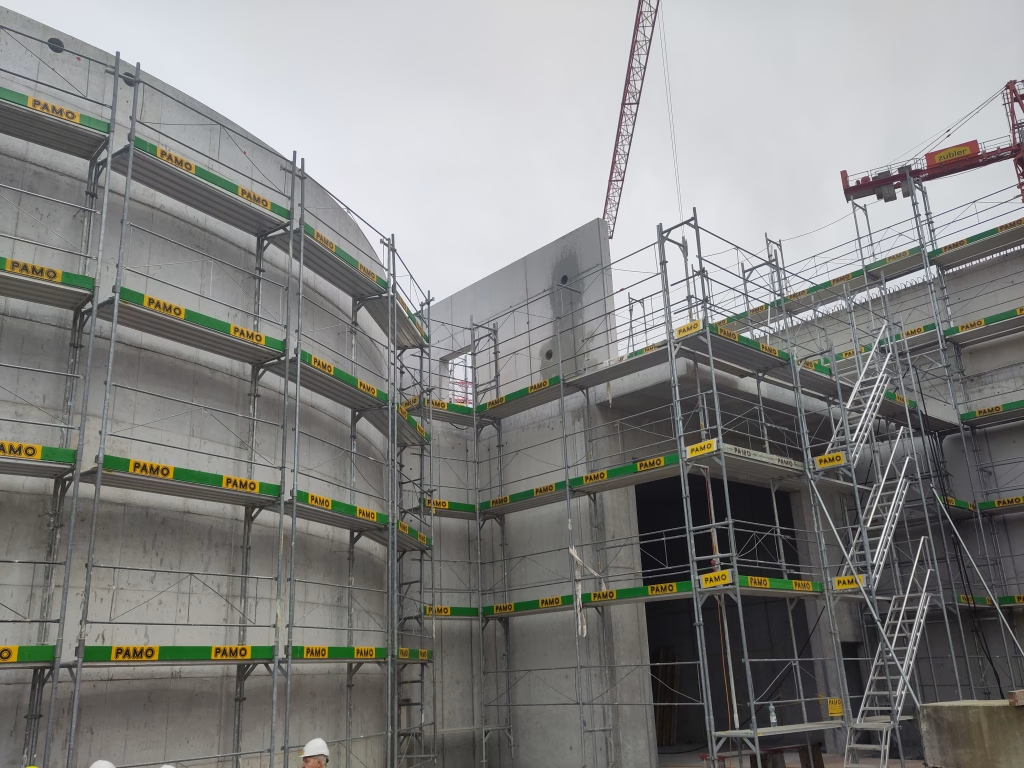
Construction products and building processes are an important part of the economy. Environmental Product Declarations (EPD) are becoming increasingly important in the construction sector. They provide transparent information about the environmental impacts of building products and are often required for sustainable building certifications, public procurement processes, and inclusion in the KBOB/ecobau database.
ESU-services supports manufacturers, industry associations, and construction companies in preparing Environmental Product Declarations in accordance with EN 15804 and in conducting the underlying Life Cycle Assessments (LCAs). With our extensive experience, we help our clients document environmental performance indicators in a transparent, traceable, and standards-compliant manner.
Our Experience with EPD and Life Cycle Assessments for Construction Products
Construction products and building processes account for a significant share of environmental impacts throughout the value chain. An Environmental Product Declaration (EPD) enables these impacts to be quantified and communicated across the entire life cycle of a product.
ESU-services regularly conducts Life Cycle Assessment studies, EPD projects, and environmental data analyses for building materials and construction products. These studies provide the foundation for Environmental Product Declarations according to EN 15804 and for inclusion in the KBOB/ecobau database.
Selected Reference Projects
LCA of Composite Materials for the Construction Sector
ComPair aims to continuously improve the environmental performance of its products and to integrate sustainability aspects at an early stage of product development.
Together with ESU-services, an LCA was carried out for the innovative HealTech™ material. The results are used for material selection, identification of environmental hotspots, and evaluation of improvement measures. In addition, CompPair uses SimaPro software to systematically integrate environmental information into its development processes.

Life Cycle Inventory of Stone Wool Production
Flumroc is one of the leading stone wool manufacturers in Switzerland.
In cooperation with ESU-services, the company’s internal LCA model was updated to reflect the latest methodologies and data sources. At the same time, the life cycle inventory data for stone wool production and key upstream processes were comprehensively revised.
The results provide a robust foundation for Environmental Product Declarations of construction products and for the environmental assessment of building materials in sustainable construction. The resulting report was published by ecobau.
Support for EN 15804 and KBOB/ecobau Requirements
We support manufacturers and industry associations with:
- Life Cycle Assessments for construction products and building materials
- Preparation of Environmental Product Declarations (EPDs) according to EN 15804
- Calculation of environmental indicators for the KBOB/ecobau database
- Data collection and modelling using SimaPro
- Interpretation of results and hotspot analyses
- Preparation for verification and publication
- Identification of improvement opportunities for products and processes
What Are the Benefits of an Environmental Product Declaration?
An Environmental Product Declaration (EPD) provides transparent information about the environmental impacts of construction products and is increasingly becoming a competitive advantage in the building sector. A verified EPD enables manufacturers to document and communicate the environmental performance of their products to customers, architects, planners, investors, and public authorities.
Today, EPDs are frequently required for public tenders, green building certification schemes such as Minergie, DGNB, LEED, or BREEAM, and for sustainability assessments of construction projects. They facilitate the inclusion of products in databases and building material lists while providing a reliable basis for environmental communication.
In addition, the preparation of an LCA provides valuable insights into the most important environmental hotspots along the value chain. This helps companies identify opportunities to improve raw material sourcing, energy consumption, transportation, and manufacturing processes, thereby reducing environmental impacts and improving resource efficiency.
An Environmental Product Declaration in accordance with EN 15804 or inclusion in the KBOB/ecobau database enhances the credibility of sustainability claims and helps companies meet the growing expectations of customers, investors, regulators, and procurement organizations.
Why Choose ESU-services?
- More than 25 years of experience in Life Cycle Assessment
- Extensive expertise in construction products and building materials
- In-depth knowledge of EN 15804, ISO 14040/14044, and KBOB/ecobau requirements
- Efficient and practice-oriented project management
- Independent and scientifically sound consulting services
Frequently Asked Questions (FAQ)
What is an Environmental Product Declaration (EPD)?
An Environmental Product Declaration describes the environmental impacts of a product throughout its life cycle based on a standards-compliant Life Cycle Assessment.
When do I need an EPD for my construction product?
EPDs are commonly required for public procurement, sustainable building certification schemes, and the transparent communication of environmental performance.
Which standards are relevant?
For construction products, EN 15804 is the key standard for Environmental Product Declarations. In Switzerland, additional requirements may apply for inclusion in the KBOB/ecobau database.
Selected publications
- Rolf Frischknecht, Matthias Stucki, Sybille Büsser, René Itten, Holger Wallbaum (2012) Technical Paper: Comparative life cycle assessment of geosynthetics versus conventional construction materials. Ground Engineering October 2012
- I. Fraser, A. Elsing, M. Stucki, S. Büsser, R., Itten, R. Frischknecht, H. Wallbaum Comparative life cycle assessment of geosynthetics versus conventional construction materials, a study on behalf of the E.A.G.M., case 4, soil retaining wall.
- Flury K. and Frischknecht R. (2012) Life Cycle Assessment of Rock Wool Insulation. ESU-services, Uster.
- Stucki M., Büsser S., Itten R., Frischknecht R. and Wallbaum H. (2011) Comparative Life Cycle Assessment of Geosynthetics versus Conventional Construction Material. Commissioned by European Association for Geosynthetic Manufacturers (EAGM), Uster and Zürich, CH.
- Dettli R., Baur M., Philippen D., Frischknecht R. and Faist Emmenegger M. (2006) Umweltwirkungen von Energiestandards: Perspektiven für den Gebäudepark Schweiz. im Auftrag des Bundesamtes für Energie BFE, Zürich/Uster.



