Scope 1, 2 and 3 according to the Greenhouse Gas Protocol
Would you like to differentiate the three categories in your carbon footprint calculations in line with the Greenhouse Gas Protocol?
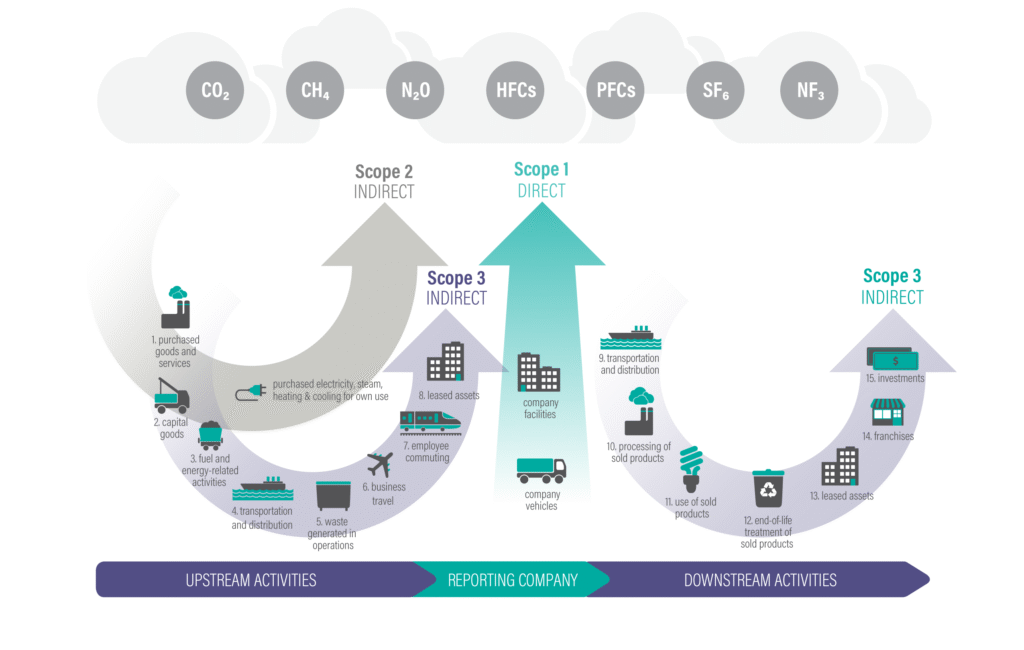
The Greenhouse Gas Protocol requires greenhouse gas emissions to be divided into Scope 1 (direct emissions at the company site), Scope 2 (emissions from power generation according to direct electricity demand), and Scope 3 (all remaining emissions). For SimaPro users who wish to perform calculations in accordance with the Greenhouse Gas (GHG) Protocol, we offer a detailed breakdown of greenhouse gas emissions from electricity datasets, as well as an extended method for evaluating emissions as a database. The modified database can be based on different unit process data such as ecoinvent or BAFU:26.
This breakdown is divided into the categories defined by the GHG Protocol, in particular Scope 2, Scope 3 excluding transmission and distribution losses (T&D), and Scope 3 T&D losses. These emission data are formatted for use in SimaPro and enable comprehensive greenhouse gas accounting. As part of our data sales offering, we can also provide a manual allocation for selected datasets on request.
Contact us directly to receive a quote.
SBTi-ready data for the entire value chain
Science Based Targets (SBTi) require greenhouse gas emissions to be accounted for in a transparent, traceable and methodologically consistent way — across the entire value chain and across Scope 1, 2 and 3.
ESU-services supports you with structured life cycle inventory data preparation and SimaPro-compatible databases, based on ecoinvent or BAFU:26, ensuring that your accounting is based on a robust and reliable data foundation.
Why Science Based Targets are becoming increasingly important for companies
Science Based Targets have become a key reference framework for corporate climate targets. Companies use them to align their emissions reductions with scientifically grounded decarbonisation pathways and to create a transparent basis for internal management, customer requirements and external communication. The Science Based Targets initiative provides the relevant standards, criteria and validation processes.
In practice, however, one thing quickly becomes clear: the quality of the target-setting process depends to a large extent on the quality of the underlying emissions data. If Scope 1, 2 and 3 are not consistently defined, if electricity data are not properly allocated, or if relevant categories are not reported transparently, this creates uncertainty in the accounting — and therefore also in the target architecture. This is exactly where a methodologically robust data structure becomes essential.
What SBTi means in practice
SBTi is based on a complete and plausible greenhouse gas inventory. In practice, this means that companies need to capture and document emissions across the three well-known categories: Scope 1, Scope 2 and Scope 3. The underlying reference system is the Greenhouse Gas Protocol, which is widely recognised as the global standard for defining and accounting for corporate emissions.
One particularly challenging area is often the treatment of indirect emissions. While Scope 1 covers direct emissions from owned or controlled sources, and Scope 2 covers emissions from purchased energy, Scope 3 includes all other indirect emissions across the value chain. In many companies, Scope 3 is data-intensive, methodologically demanding and often decisive for the overall carbon footprint.
Typical challenges in the data basis
Many companies are no longer asking whether they should account for emissions, but rather how precise and robust their accounting needs to be in order to support target setting and internal management. In practice, we regularly encounter similar challenges:
Inconsistent scope allocation
If emission sources are not assigned consistently across the scopes, inconsistencies arise between accounting, reporting and target setting. This is especially critical in the areas of electricity, energy supply and upstream value chains.
Datasets that are too coarse or insufficiently transparent
Generic emission factors can be useful for initial estimates, but they are not always sufficient when more differentiated analyses or a transparent methodological basis are required. Robust decision-making often requires a more granular data structure.
Unclear treatment of electricity datasets
Purchased electricity in particular requires a detailed breakdown when assigning emissions to Scope 2 and Scope 3. Transmission and distribution losses (T&D) may require further differentiation if the accounting is to be methodologically sound. Your existing product page already addresses this topic explicitly.
How ESU-services supports you
As part of its life cycle inventory data offerings, ESU-services provides a structured preparation of greenhouse gas emissions data for Scope 1, 2 and 3. The aim is to provide companies with a methodologically robust data basis that can be integrated into existing accounting and modelling processes.
Specifically, the offer includes:
- disaggregated databases for SimaPro to differentiate between Scope 1, 2 and 3,
- based on different ecoinvent or BAFU:26 versions,
- a detailed breakdown of emissions from electricity datasets,
- a separation into Scope 2, Scope 3 excluding transmission and distribution losses, and Scope 3 T&D losses,
- and, where required, a manual allocation of selected datasets.
This means that ESU does not primarily support companies through general strategy consulting, but through what is often crucial for implementation: a robust, usable and well-documented data structure.
Our contribution to SBTi readiness
Anyone aiming to develop Science Based Targets needs an emissions baseline that is both methodologically sound and practically usable within the organisation. ESU-services provides this basis by preparing relevant emissions data in such a way that they fit into a consistent scope logic and can be further processed in SimaPro. This is particularly relevant for companies looking to professionalise their accounting, improve internal modelling, or refine their existing data basis for scope analyses.
ESU’s role lies primarily in the structuring and differentiation of the data basis — not in offering broad, generic “SBTi consulting”. For many companies, however, this is exactly where the bottleneck lies: the challenge is often not the intention to set targets, but the methodologically sound translation of that intention into usable data.
How collaboration typically works
1. Clarifying the starting point and the specific need
In the first step, we discuss the key question at hand: Is the focus on differentiating Scope 1–3, on electricity datasets, on individual LCA datasets, or on building a consistent data basis for broader greenhouse gas accounting? Which background database version of ecoinvent or BAFU:26 should be used? Based on this, we can determine which type of data preparation makes the most sense.
2. Defining the appropriate data structure
We then define which datasets need to be disaggregated and which categories are required. Depending on the use case, this may involve a standard solution based on the available data packages or a targeted manual allocation of selected datasets.
3. Providing the data
The prepared emissions data are delivered in a format suitable for SimaPro. For SimaPro users with a valid ecoinvent licence, the relevant database packages can be used directly.
4. Integration into your accounting
The data can then be integrated into your existing greenhouse gas accounting, modelling or internal analysis. This creates more transparent scope boundaries and a more robust basis for further work in the context of climate targets and reporting.
What you receive from ESU
With ESU-services, you do not receive generic off-the-shelf consulting, but a technically sound data solution for greenhouse gas accounting. Depending on your needs, this may include:
- Scope 1–3 structuring of emissions data,
- breakdown of electricity datasets according to scope logic,
- SimaPro-compatible databases,
- methodologically transparent differentiation of individual datasets,
- and a robust basis for further emissions analysis.
This is a practical advantage especially for companies working with LCA methodology, SimaPro, BAFU:26 or ecoinvent: the data basis is not only theoretically sound, but directly compatible with existing applications and processes.
When FLAG also becomes relevant
For companies with land-related emissions — for example in land-intensive supply chains or in raw material systems linked to land use, forestry or agriculture — additional requirements from the SBTi FLAG framework may become relevant alongside the classic Scope 1–3 requirements. The SBTi addresses these emissions in a separate framework because land-related emissions and removals must be treated differently from energy and industrial emissions.
For such cases, ESU offers a separate breakdown of LUC, biogenic CO₂ and other emissions in the primary sector.
You would like to structure your Scope 1–3 data basis for SBTi-related questions or have specific datasets disaggregated?
Talk to us about your data needs.
FAQ on the SBTi data basis
What role do Scope 1, 2 and 3 play in Science Based Targets?
Science Based Targets are based on a transparent and traceable emissions inventory. To achieve this, emissions must be defined and documented consistently across Scope 1, 2 and 3. The basis for this is the Greenhouse Gas Protocol.
What exactly does ESU offer for scope differentiation?
ESU provides disaggregated databases for SimaPro as well as a breakdown of ecoinvent electricity datasets into Scope 2, Scope 3 excluding T&D, and Scope 3 T&D losses. In addition, selected datasets can be allocated manually if required.
Do I need SimaPro and ecoinvent for this?
The offer described here is aimed at SimaPro users. A valid ecoinvent licence is required for the use of certain datasets.
Is FLAG part of the same accounting system?
FLAG is a complementary SBTi framework for land-related emissions. It becomes relevant when emissions from land use, forestry or agriculture play a significant role.



