What Companies Should Consider for Decision Making
If your company is planning to publish an Environmental Product Declaration (EPD), choosing the right platform is one relevant decision in the process besides choosing the software, the background database, the verifier or the LCA consultant. The platform is more than a place to host the final document: It influences verification quality, transparency, flexibility, and how easily your EPD can be used in the market.
Because the choice of platform affects both the publication process and the long-term usability of your EPD, it should not be based on price alone. A low-cost or fast solution may be attractive at first, but it can create limitations later if the platform lacks transparency, flexibility, or professional support. The right choice depends on your products, your target markets, and how you plan to manage EPDs over time.
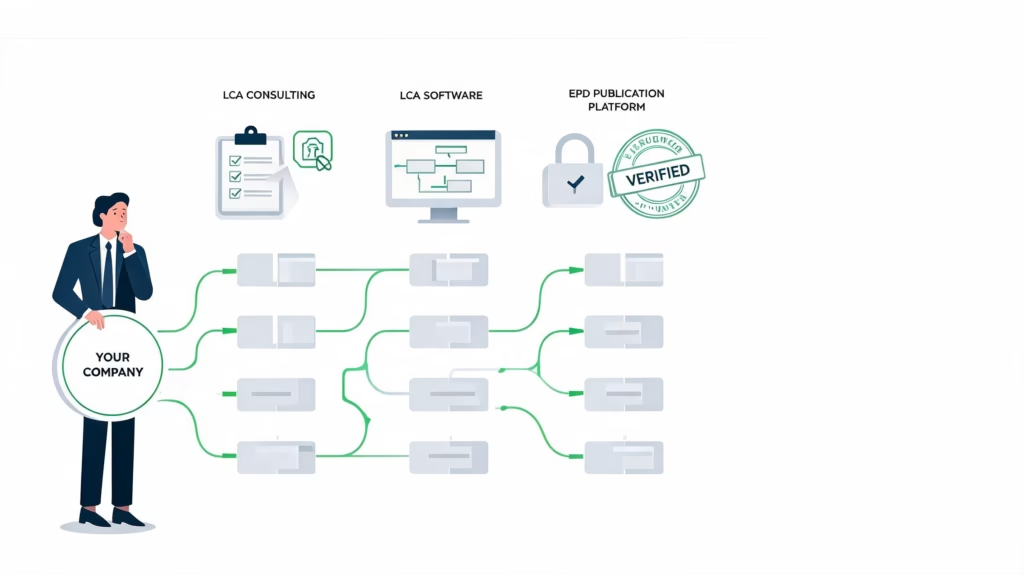
Are you new to the topic and would like to speak to an expert or request an offer for detailed consulting or even a fully prepared EPD study for your product(s)?
Independence and transparency of EPD Platform
A credible EPD platform should operate with clear independence from single consultants, database or software providers, and other commercial interests. This separation helps avoid conflicts of interest and strengthens trust in the publication process.
When evaluating a platform, look for transparent governance, clear ownership structures and understandable decision-making processes. You should be able to see who operates the platform, how verification is organised, and whether the roles of platform operator, verifier, LCA consultant, database and software provider are clearly separated.
Questions worth asking include:
- Who owns and operates the platform?
- Are governance and decision-making processes transparent?
- Are there any commercial links between the platform, verifiers, consultants, or software vendors?
- Are the contractual terms clear and fair?
A platform with open governance and clear role separation is generally easier to trust and easier to work with in the long run.
Quality of EPD verification
Verification is the backbone of a credible EPD. A platform may offer fast publication, but if the verification process is weak, the EPD may not deliver the reliability your customers or stakeholders expect.
Strong verification depends on experienced professionals who understand both LCA methodology and EPD development. Verification should be more than a formal checklist exercise. It should include expert judgement, the ability to review methodological choices, and a process for resolving complex issues.
When assessing verification quality, consider the following:
- Do verifiers have practical experience in LCA and EPD work?
- Is there a clear review process with the possibility for feedback rounds?
- Are the qualifications and expertise of verifiers transparent?
- Is there room for technical discussion when methodological questions arise?
Be cautious if verification appears to rely mainly on automated checks or rigid checklists without meaningful expert involvement. Automation can support the process, but it should not replace professional assessment.
Cost versus long-term value
Price matters, but it should be considered in relation to the full value a platform provides. A low initial fee may seem attractive, yet additional costs can appear later through revision fees, limited support, contract restrictions, or the need to reissue an EPD under another system.
For companies planning to use EPDs strategically, it is worth considering the total cost over time rather than only the first publication fee. A platform that appears inexpensive at the start may become costly if it lacks flexibility or if it creates barriers to updating and reusing your data.
Look for:
- Transparent pricing with clearly defined publication, revision, and renewal costs.
- No hidden charges in the contract.
- A service model that matches your expected publication volume.
- Pricing that reflects both quality and support, not just speed.
A good platform should offer value, not just a low entry price.
Flexibility and future-proofing
EPD requirements are evolving. Companies may need to respond to new regulations, digital product information requirements, customer demands, or changes in standards. A platform should therefore support not only today’s publication needs, but also future developments.
Flexibility is especially important if your company plans to publish multiple EPDs, update existing declarations, or use different software tools over time. You should be able to keep control over your own data and avoid being locked into one workflow or one provider.
Important questions include:
- Does the platform support the LCA software tools your team or consultant uses?
- Can your LCI data and models be reused later?
- Are there restrictions if you want to switch platforms in the future?
- Is the platform prepared for upcoming regulatory changes?
A future-ready platform should make it easier, not harder, to adapt as your needs change.
Support and process integration in the EPD platform
Even a strong platform can become difficult to use if the workflow is confusing or the support is weak. For companies that are publishing an EPD for the first time, the process should be understandable, structured, and supported by knowledgeable people.
Good process integration saves time and reduces the risk of errors. This includes clear submission steps, access to applicable programme rules, and practical support when questions arise. Human support is especially valuable when methodological or contractual issues need clarification.
Useful features include:
- Clear step-by-step workflows.
- Easy access to programme rules and applicable PCRs.
- Responsive support from qualified staff.
- Training materials that explain the process clearly.
A platform should help make the publication process manageable, not add unnecessary complexity.
Recognition and market trust
The value of an EPD depends not only on how it is produced, but also on how it is received by the market. A platform with strong recognition can improve trust among customers, consultants, buyers, and other stakeholders.
For companies, market acceptance matters because an EPD is often used in procurement, product comparisons, sustainability reporting, or building-related certification processes. If a platform is well recognised, the EPD is more likely to be accepted without additional explanation or effort.
Signs of strong market trust include:
- Broad acceptance across relevant markets.
- Following ECO Platform Standards
- Established reputation and consistent publication practice.
- Compatibility with recognised frameworks and industry expectations.
- A history of reliable and transparent operations.
Recognition does not guarantee quality, but it is an important signal when combined with the other criteria in this article.
Common pitfalls to avoid
Companies often make similar mistakes when choosing an EPD platform. Some of these mistakes are driven by time pressure, while others come from focusing too narrowly on cost or convenience.
Common pitfalls include:
- Choosing only on the basis of price or speed.
- Ignoring the quality of verification.
- Overlooking ownership structures and potential conflicts of interest.
- Accepting restrictive contract terms without reviewing them carefully.
- Assuming that software or automation can replace expert judgement.
A platform should support a robust and credible EPD process. If a decision creates hidden risks later, it may not have been the right choice, even if it seemed efficient at the beginning.
How ESU-services supports your decision for an EPD platform
Choosing an EPD platform is a strategic decision that affects quality, flexibility, and long-term usability. For companies that want to publish EPDs with confidence, it can be helpful to evaluate platform options in a structured and independent way.
As an LCA and EPD consultancy, we support companies in assessing platform options based on transparency, verification quality, market acceptance, and fit with their project needs. We do not approach the topic from a single-platform perspective. Instead, we help identify the solution that best matches your goals, your products, and your long-term plans.
If your company is preparing its first EPD or reviewing current publication options, an independent assessment can help avoid unnecessary risks and create a more reliable path from LCA development to publication.
Final thought
The cheapest or fastest platform is not always the best one. For companies planning to publish an EPD, the better question is whether the platform offers the right combination of credibility, transparency, support, and future flexibility.
A well-chosen platform can make EPD publication smoother and more robust. A poorly chosen one can create avoidable costs, complications, and limitations. The right decision starts with looking beyond price and evaluating the platform as part of a broader, long-term EPD strategy.
ESU-services stands for fair consulting in sustainability and assists you independently to find the best EPD platform according to your needs and expectations. Most of them work within the Eco-Platform network. So far, we have mainly worked with the international EPD®system, IBU-Bau, KBOB and PEP (but are also open to cooperate with other organisations). The following table shows platform operators for registration and publication of EPDs with which ESU cooperated in the past.
| System | Region | Focus | |
|---|---|---|---|
 | The international EPD®system (environdec) | GLO, English and other languages | All types of products |
 | EPD South-East Asia | Asia | All types of products |
 | IBU-Bau | DE and German speaking, | Building products |
 | KBOB, ecobau and IPB | CH, German and English | Building products |
 | PEP ecopassport (product Environmental Profile) | FR, GLO | Electric and electronic products |
 | Product environmental Footprint (PEF) | EU | Consumer products |



