Why Many Get It Wrong and How to Fix It

As an EPD verifier for EPD International, IBU, KBOB and other programme operators, I frequently encounter the same methodological issue in EPD submissions: electricity modelling that reflects greenhouse-gas protocol accounting principles rather than life cycle assessment (LCA) methodology.
While this distinction may appear subtle, it can have a substantial influence on results. Depending on the electricity mix, voltage level and modelling assumptions, the environmental impacts associated with electricity can differ significantly. In some cases, incorrect modelling can materially affect the results reported in an EPD and lead to extensive revision requests during verification.
Scope Logic Versus LCA Logic
Corporate greenhouse-gas accounting and life cycle assessment serve different purposes and therefore apply different modelling principles.
Purchased electricity is generally reported as Scope 2 emissions, while on-site generation may fall under Scope 1 according to the Greenhouse Gas Protocol. Contractual instruments such as Guarantees of Origin can significantly influence reported Scope 2 emissions.
EPDs, however, are based on life cycle assessment according to ISO 14040, ISO 14044, ISO 14025 and, for construction products, EN 15804. In an LCA, we model environmental impacts across all relevant life cycle stages and therefore consider all upstream processes associated with electricity supply from a cradle-to-grave perspective.
This typically includes:
- Fuel extraction and processing
- Construction of power plants
- Electricity generation
- Transmission and distribution
- Transformation between voltage levels
- Grid infrastructure
- Maintenance activities
- Electricity losses
- Other relevant emissions associated with electricity supply systems
LCA does not classify emissions into Scope 1, Scope 2 and Scope 3 categories. Instead, all relevant processes within the defined product system are modelled consistently according to the applicable standards.
Why Does It Matter?
The following example illustrates the importance of modelling assumptions for hydropower electricity.
The results are based on a BAFU:25 database based electricity model and show how different system boundaries can influence the climate-change impact associated with one kilowatt-hour of run-off river hydropower electricity.
- When a hydropower facility generates and consumes electricity directly on site without using the public grid, the associated climate change impact amounts to 0.0037 kg CO₂-eq/kWh. But, this is only correct if the power plant is directly located at the factory that consumes the electricity (e.g. as for roof-top PV power plants).
- If transformation infrastructure and distribution equipment are included, and transmission losses are estimated to be provided also by hydropower, the result increases to 0.011 kg CO₂-eq/kWh.
- If one considers that the German residual mix covers transmission and distribution losses rather than additional hydropower generation, the climate change impact increases to 0.079 kg CO₂-eq/kWh.
This is finally about 20 times higher than the pure production of the consumed electricity!
This example demonstrates a key point: renewable electricity generation can have relatively low environmental impacts, but delivering that electricity to the user can cause substantially higher impacts.
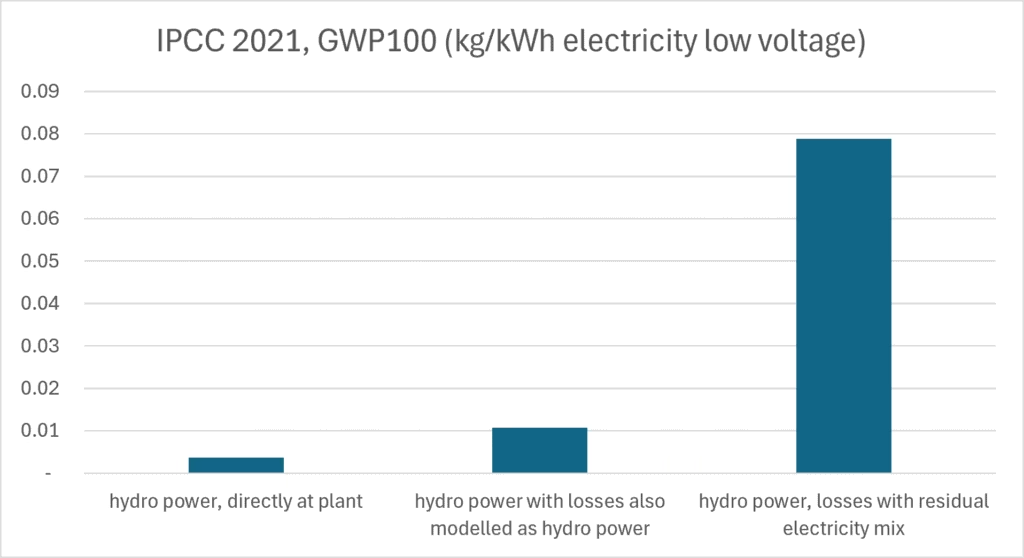
Figure: Carbon footprint of electricity from hydropower supplied directly at the power plant compared with electricity delivered through the public grid, including transmission and distribution losses.
Key Aspects of Electricity Modelling in EPDs
Supplied Electricity Mix
Electricity used in manufacturing should be modelled using the actual electricity product purchased whenever sufficient evidence is available. Acceptable documentation may include:
- Guarantees of Origin (GoD) or equivalent attribute certificates
- Electricity contracts
- Electricity invoices
- Supplier statements
- Evidence of certificate cancellation where applicable
The objective is to demonstrate both the quantity and the environmental attributes of the electricity used during the reporting period.
Only contractual instruments that provide traceability, avoid double counting and comply with applicable regulations should be used.
For example:
- Germany: Documentation is typically provided through the Umweltbundesamt Herkunftsnachweisregister (HKN) or an equivalent recognised system. Depending on the circumstances, the proportion of electricity supplied in accordance with the EEG subsidies may also need to be taken into account for both the local mix and the residual mix. Some databases do not currently take this into account for the residual mix.
- Austria: Usual model the supply mix according to declaration on electricity invoices (=contractual instrument). Check if it is valid for the correct period and specific for the supplier. Austria does not provide a residual electricity mix because suppliers disclose the origin of all electricity sold under a system of full consumption disclosure. Therefore, practitioners should not use the average consumption mix in module A3. Documentation is typically also available through E-Control.
- Switzerland: Documentation is typically available through Pronovo or the local supplier (example for our own electricity mix in Schaffhausen). Supplier mixes published for several years and suppliers can be searched.
- Italy: Note: The ecoinvent v3.12 dataset for residual electricity on low and medium voltage level underestimates the impacts considerable by estimating other fossil ressources with waste incineration energy. It is recommended to use the consumption mix or to model a correct mix starting from high voltage mix.
- Other countries: Equivalent national or recognised certificate registries may apply.

Acceptance ultimately depends on the requirements of the applicable programme operator, PCR and verifier.
Voltage Level of Supply
Electricity losses differ substantially depending on the voltage level at which electricity is supplied. Typical values are:
| Voltage level | Typical losses |
| High voltage (220–380 kV) | approximately 2–4% |
| Medium voltage (1–110 kV) | approximately 4–6% |
| Low voltage (<1 kV) | approximately 6–10% |
The selected background datasets should therefore correspond to the actual supply voltage whenever possible. Many modern LCI databases already provide separate datasets for high-, medium- and low-voltage electricity products.
Modelling of Electricity Losses in LCA as residual mix
One frequently overlooked aspect is the treatment of electricity losses. In most systems, Guarantees of Origin are only cancelled for the quantity delivered to the customer, while transmission and distribution losses are not explicitly covered by contractual instruments.
In these situations, it is appropriate to model losses using the national residual mix. The residual mix represents the electricity attributes remaining after contractual allocation of renewable electricity certificates and may provide a reasonable representation of electricity used to cover grid losses when these losses are not otherwise documented.
When detailed information is unavailable, using the loss factors and modelling approaches included in established background databases is generally a practical and robust solution.
Infrastructure for electricity transmission and transformation
Unlike simplified greenhouse-gas accounting approaches, LCA generally includes infrastructure associated with electricity supply. Relevant infrastructure may include:
- Power plant construction and decommissioning
- Transmission lines
- Transformers
- Substations
- Distribution networks
- Maintenance activities
Most established LCI databases already include these processes at least for average electricity datasets on different voltage levels.
SF₆ Emissions during electricity transformation
Sulfur hexafluoride (SF₆) is widely used in high-voltage electrical equipment because of its excellent insulation properties. However, SF₆ also has an extremely high global warming potential. Consequently, small leakage emissions can make a significant contribution to the climate-change impacts associated with high-voltage electricity transmission and distribution. SF₆ emissions should therefore be included in electricity modelling. Suitable estimates should be available in the LCA background database.
Practical Implementation
The exact implementation depends on the software and database used. The general approach is usually as follows:
- Identify the electricity product purchased by the organisation.
- Obtain supporting documentation for the electricity mix.
- Select appropriate generation datasets representing the purchased electricity.
- Model transmission and distribution at the correct voltage level.
- Account for electricity losses using a justified and documented approach.
- Consider the infrastructure processes included in the background database.
- Verify that all assumptions, data sources and calculations are documented.
These steps can often be implemented efficiently while maintaining transparency and reproducibility by using of parameterised electricity models.
Documentation Requirements
Regardless of the modelling approach chosen, documentation is essential. Electricity modelling should be transparent, reproducible and verifiable. The documentation should generally include:
- Electricity consumption data
- Electricity invoices
- Supplier information
- Guarantees of Origin or equivalent certificates
- Registry references where applicable
- Assumptions regarding losses
- Voltage level assumptions
- Residual mix assumptions
- Selected LCI datasets
- Calculation procedures
For future electricity contracts covering the EPD validity period, some programme operators may accept documented commitments or declarations from the manufacturer. However, the exact requirements depend on the applicable programme rules and should always be verified.
Without sufficient documentation, verifiers will typically require the use of conservative default assumptions or standard electricity datasets consistent with the applicable PCR and programme instructions.
Sumary of Common Modelling Errors
The most frequent issues observed during verification include:
| Common mistake | Why it is problematic | Preferred approach |
| Using Scope 2 values directly | Does not represent a full life cycle inventory for electricity supply | Use LCI datasets representing the full electricity supply chain |
| Assuming “renewable” or “green” electricity has zero impact | Ignores generation infrastructure, distribution losses and upstream processes | Use technology-specific LCA datasets |
| Using national average electricity without justification | May not represent the actual electricity purchased | Model the documented electricity mix where allowed |
| Ignoring electricity losses | Underestimates impacts associated with electricity supply | Include losses at the appropriate voltage level and quality level (usually residual mix) |
| Excluding infrastructure | May underestimate impacts and reduce consistency | Use complete LCI datasets including infrastructure |
| Neglecting SF₆ emissions where relevant | May underestimate climate-change impacts | Include SF₆ contributions where represented in the dataset |
Regulatory Basis for Electricity Modelling in EPDs
Electricity modelling in EPDs is not governed by a single clause but by the combined requirements of ISO 14040, ISO 14044, ISO 14025, EN 15804 and programme-specific instructions.
EN 15804 requires construction product EPDs to be based on life cycle assessment principles and representative life cycle inventory data. Electricity used in manufacturing should therefore be modelled using datasets that adequately represent generation, transmission and distribution processes rather than relying solely on corporate greenhouse-gas accounting values.
The standard also requires transparency regarding data sources, assumptions and modelling choices that influence the declared environmental performance. Please document clearly in the project documentation, electricity mixes, certificates, residual-mix assumptions and voltage-level modelling.
The General Programme Instructions (GPI 5.0.1) of the International EPD System contain additional requirements concerning verifiable life cycle modelling, transparency and reporting of electricity used within processes under the control of the EPD owner. Electricity modelling assumptions and associated climate impacts should therefore be properly documented and traceable.
Recent updates to the International EPD System have also strengthened alignment with EN 15804 and ECO Platform requirements and placed greater emphasis on market-based electricity modelling, traceability of contractual instruments and avoidance of double counting.
IBU-Bau PCR Part A for construction products builds upon EN 15804 and introduces additional requirements regarding data quality, representativeness, allocation principles, transparency and documentation. These requirements apply equally to electricity modelling and should be considered whenever supplier-specific electricity mixes, Guarantees of Origin or residual mixes are used.
Conclusions for the modelling of electricity supply in EPDs
Electricity modelling in EPDs is often treated as a simple data input, but it is one of the most influential and frequently misunderstood aspects of life cycle assessment.
The key principle is straightforward: electricity should be modelled according to LCA rules rather than corporate greenhouse-gas accounting logic.
Good practice generally includes:
- Using representative electricity datasets
- Modelling the documented purchased electricity mix where justified
- Accounting for transmission and distribution losses
- Considering voltage level effects
- Including relevant infrastructure processes
- Considering SF₆ emissions where relevant
- Maintaining complete and transparent documentation
A robust and transparent modelling approach not only improves the scientific quality of an EPD but also facilitates a smoother verification process and increases confidence in the published results.
Practical Implementation in SimaPro Key Parameter model
To simplify correct modelling, ESU-services has developed a key parameter model in SimaPro based on:
These parameterized models allow you to:
- Quickly entry the electricity mixe
- Choose the correct supply mix for losses
- Automatically account for voltage-level losses
- Include all relevant upstream processes
- Generate consistent, verifier-ready results
Our modelling setup in SimaPro format can include dozens of pre-configured parameters covering:
- All major generation technologies (hydro, wind, PV, nuclear, fossil)
- Import/export mixes for key European countries
- Grid loss factors
- CHP and waste incineration allocations
- Country-specific residual mixes
Disclaimer
This article provides general guidance based on current LCA practice and verification experience. Requirements may differ between programme operators, PCRs, jurisdictions and future revisions of standards and guidance documents. Please check your modelling decisions always against the applicable standards, PCRs and programme instructions for the product under assessment. Verification outcomes depend on the quality of data, documentation and compliance with programme-specific requirements.
About the Author
Niels Jungbluth is an EPD verifier and life cycle assessment practitioner with extensive experience in electricity modelling, environmental product declarations and environmental footprint methods. The observations presented in this article are based on practical experience from EPD verification activities and life cycle assessment studies across multiple industry sectors.
First published: 10 July 2026



